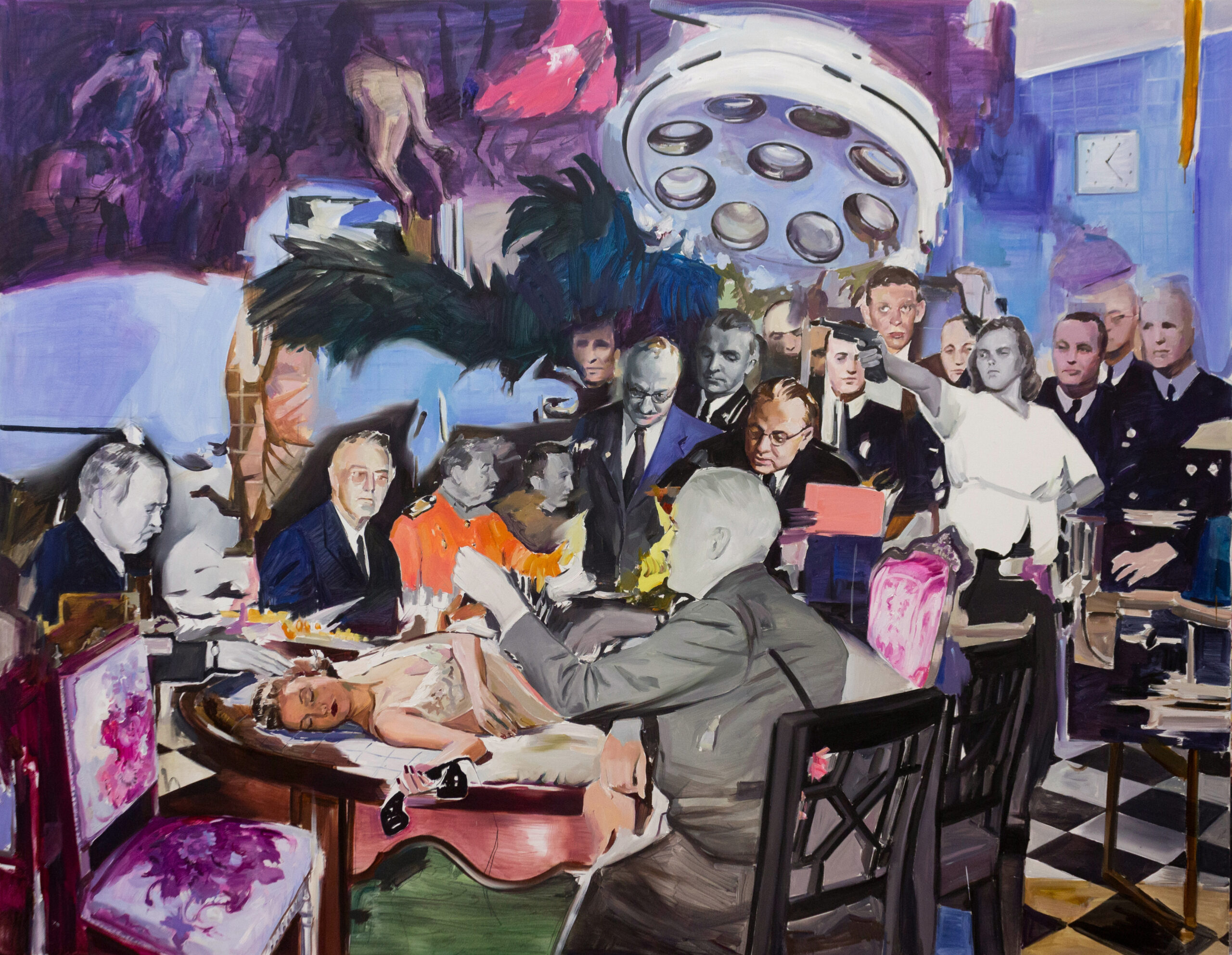

Under the Chandelier – Liza Sivakova
Galerie Eric Mouchet Brussels is pleased to present Under the Chandelier, the first solo exhibition in Belgium of Liza Sivakova (b. 1997, Russia), a painter working between Dresden and Paris.
Beneath the chandeliers of bourgeois living rooms, opulent dining rooms and hushed offices, Liza Sivakova’s paintings depict interiors where decorum quietly unravels: an elephant crashes into a dinner party, a man collapses beneath a table, a woman dances barefoot on a Persian rug while, around her, suited figures carry on their conversations as if nothing were happening. Under the Chandelier brings together a group of recent paintings, alongside pastels and collages, that explore, beneath a veneer of elegance and ceremony, the mechanisms through which power is staged, normalised, and passed on.
Trained at the St. Petersburg Academy of Fine Arts, and later at the Hochschule für Bildende Künste Dresden and the École nationale supérieure des Beaux-Arts de Paris, Liza Sivakova has spent the past several years developing a painting practice that investigates the visual mechanisms through which power is constructed, legitimised, and remembered. Combining archival imagery, found photographs, collage, and her own materials, she creates multilayered, transhistorical paintings in which historical realities and fiction converge, and in which identifiable historical figures appear alongside vividly coloured contemporary elements, allowing different temporalities to coexist within a single pictorial space.
Growing up in post-Soviet Russia, and witnessing the gradual consolidation of an authoritarian regime, profoundly shaped Sivakova’s artistic practice. Rather than depicting specific historical events, her paintings explore the visual strategies through which political authority is constructed, normalised, and sustained, and the ways these mechanisms permeate everyday life. Moving between personal experience and collective history, her work questions how ideology, patriarchal structures, and inherited images continue to shape contemporary society. Through recurring symbols, layered imagery, and deliberate shifts between monochrome and colour, her paintings resist linear narratives and instead invite multiple readings, blurring the boundaries between documentation, memory, and fiction.
In her own words, her artistic themes are rooted in her biography as a young woman in twenty-first-century Russia, with all the structural constraints and inner contradictions that entails. Her work addresses power relations, gender inequality, mental health, the overlooking of social vulnerabilities, and control exercised through authoritarian structures. Working with symbols, associations, and emotions, she seeks to create a dark, oppressive atmosphere in which ambiguous scenes emerge, aiming to provoke a sense of disorientation and unease.
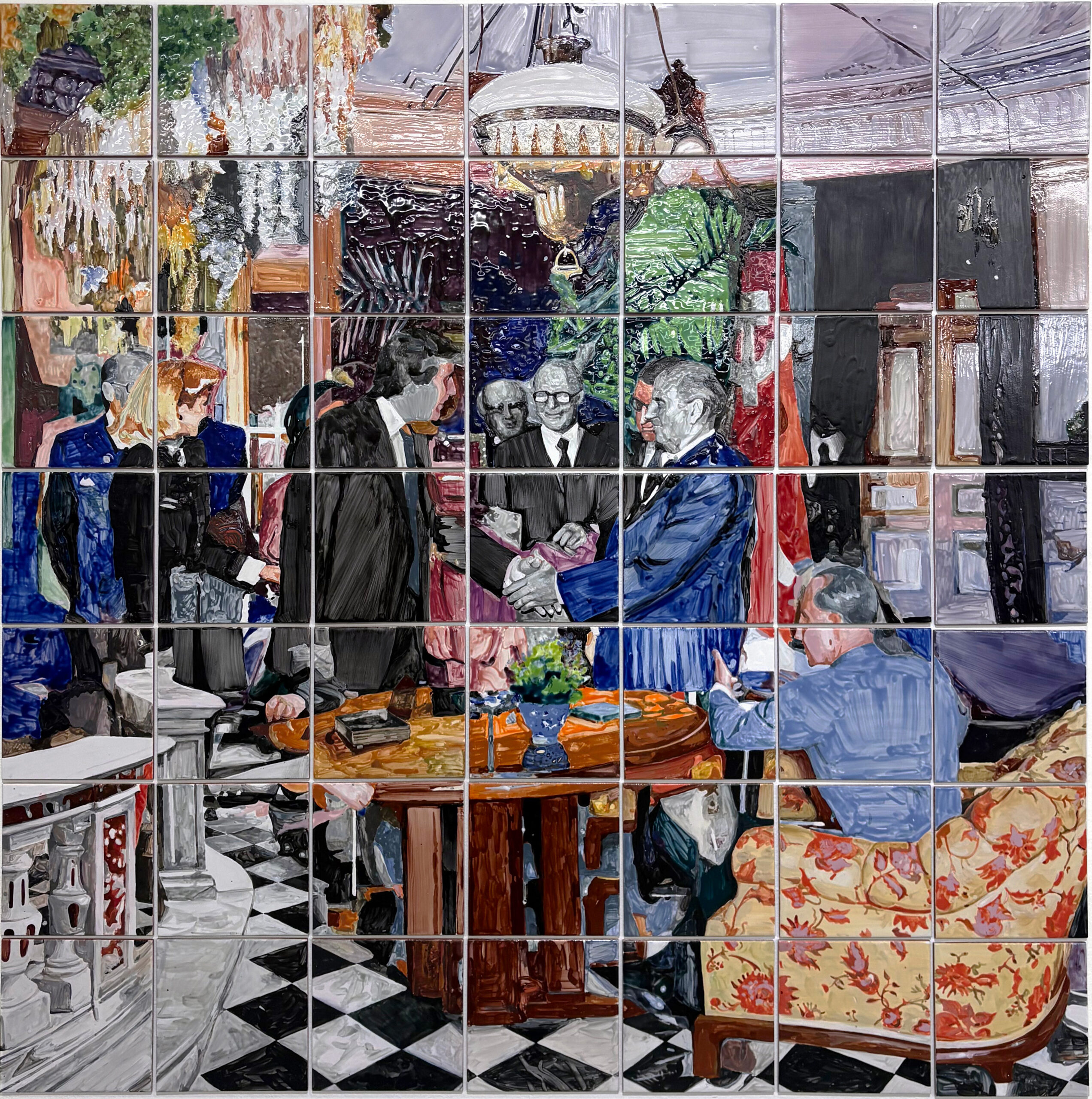
Under the Chandelier brings together a group of the artist’s recent oil paintings. The Elephant in the room series (2026), which sets much of the exhibition’s tone, depicts the animal, incongruous and massive, bursting into hushed bourgeois interiors, whether a formal dinner, a bedroom, or an opulent salon, while the other figures appear entirely unbothered by its presence. Siesta (2026) and Feeding Time (2026) continue this tipping of the domestic scene into the uncanny, while Peace Treaty? III (2025), drawing on historical diplomatic iconography, questions the staging of power and state reconciliation. The two panels of Dancing Queen (2026) depict dancing figures caught in an almost unravelling motion, beneath the chandeliers and lanterns of ceremonial rooms, poised between ritual and loss of control.
The exhibition also presents a new body of pastels on paper mounted on wood alongside several paper collages made from archival photographs and worked over with tempera, in which Sivakova continues her ongoing work of recomposing the historical image. While oil painting forms the core of her practice, Sivakova also works with glazed ceramic tiles, extending her investigation of image-making and historical representation into other media and scales.
Sivakova’s work is held in the collections of the Städtische Galerie Dresden, the STRABAG Art Collection, and the Kunstsammlung des Bodenseekreises. She was selected for the Fresh A.I.R. Scholarship Programme of Stiftung Berliner Leben, received the Förderpreis des Bodenseekreises (2026) and the First Prize of the 47th Kunstpreis of the Kulturstiftung der Sparkasse Karlsruhe (2024), and was shortlisted by the jury of the STRABAG Art Award in both 2024 and 2026. She also received the Emerging Artist Award from the Royal Institute of Oil Painters in London (2022) and the Gold Medal of the St. Petersburg Academy of Fine Arts (2015).
Her work was the subject of an ARTE documentary in 2024 («Liza Sivakova und das Napoleon Phänomen»), as well as several features in the German press. Alongside her studio practice, she will teach painting at the 29th Dresden International Summer Academy for Visual Arts (riesa efau) in summer 2026. Recent exhibitions include the Kunstmuseum Heidenheim («Die ganze Zeit»), Motorenhalle Dresden («berühren[d]»), The Grass is Greener gallery in Leipzig («On the Other Side»), Schloss Britz in Berlin, as well as the BMW Foundation Herbert Quandt in Munich and the Cour vitrée of the École nationale supérieure des Beaux-Arts de Paris.
MORE INFORMATION:
// Liza Sivakova
// Press release
// Under the Chandelier (10/09-31/10/26 | Bruxelles)
Category:
Exhibitions
Liza Sivakova, Dancing Queen III, huile sur toile, 120 x 100 cm, 2026
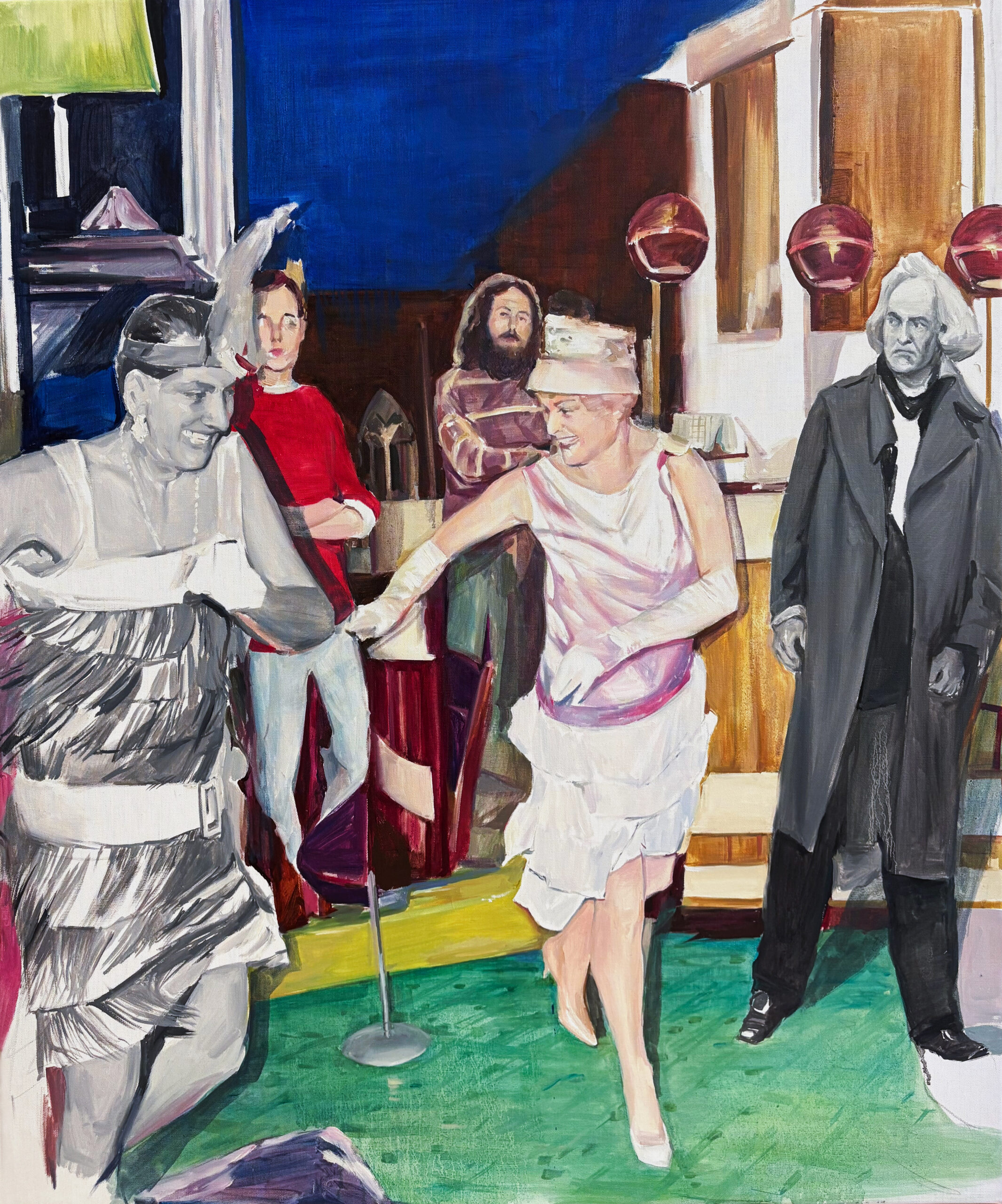
Liza Sivakova, Dancing Queen IV, huile sur toile, 120 x 100 cm, 2026
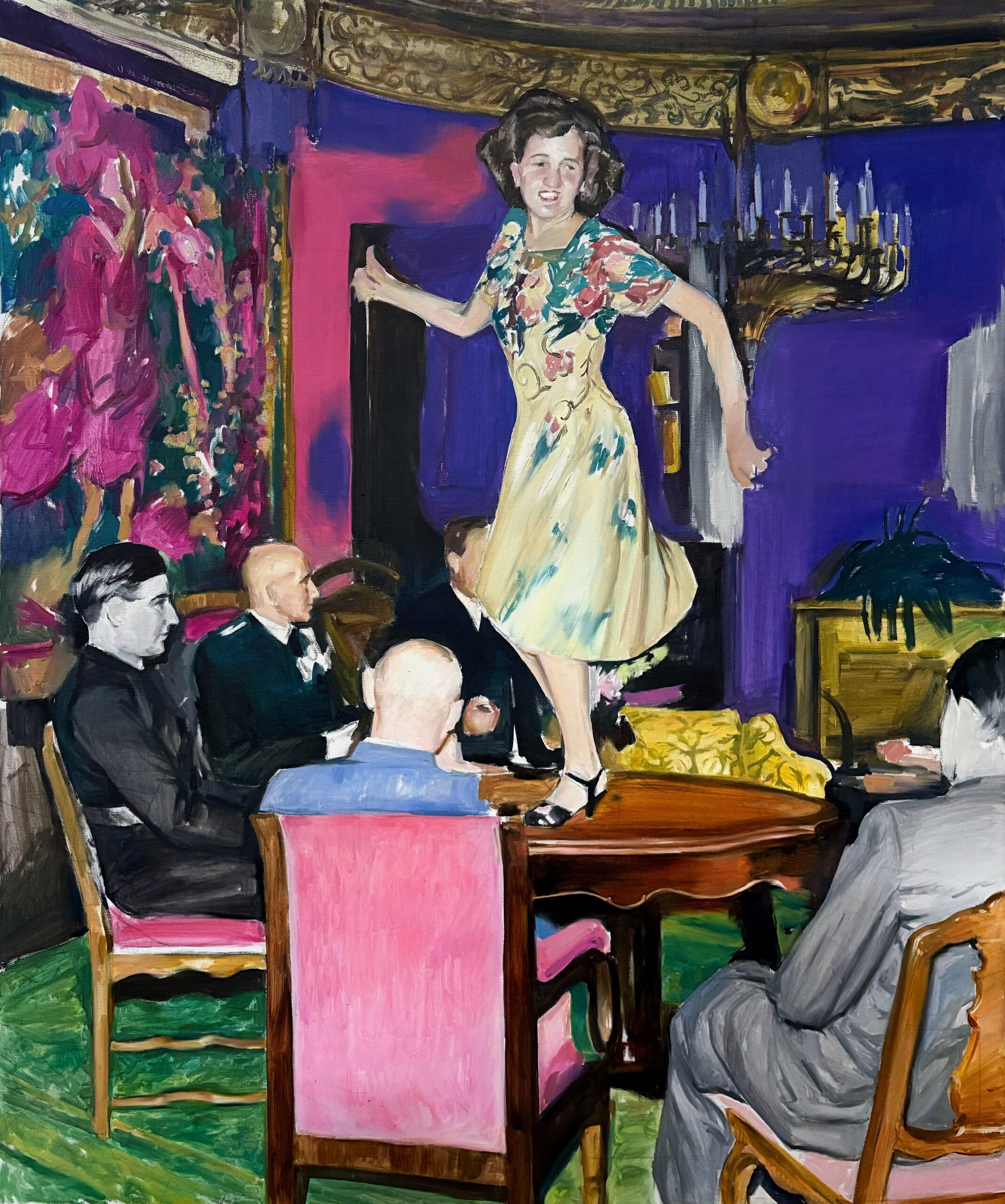
Liza Sivakova, Elephant in the room I, huile sur toile, 130 x 162 cm, 2026
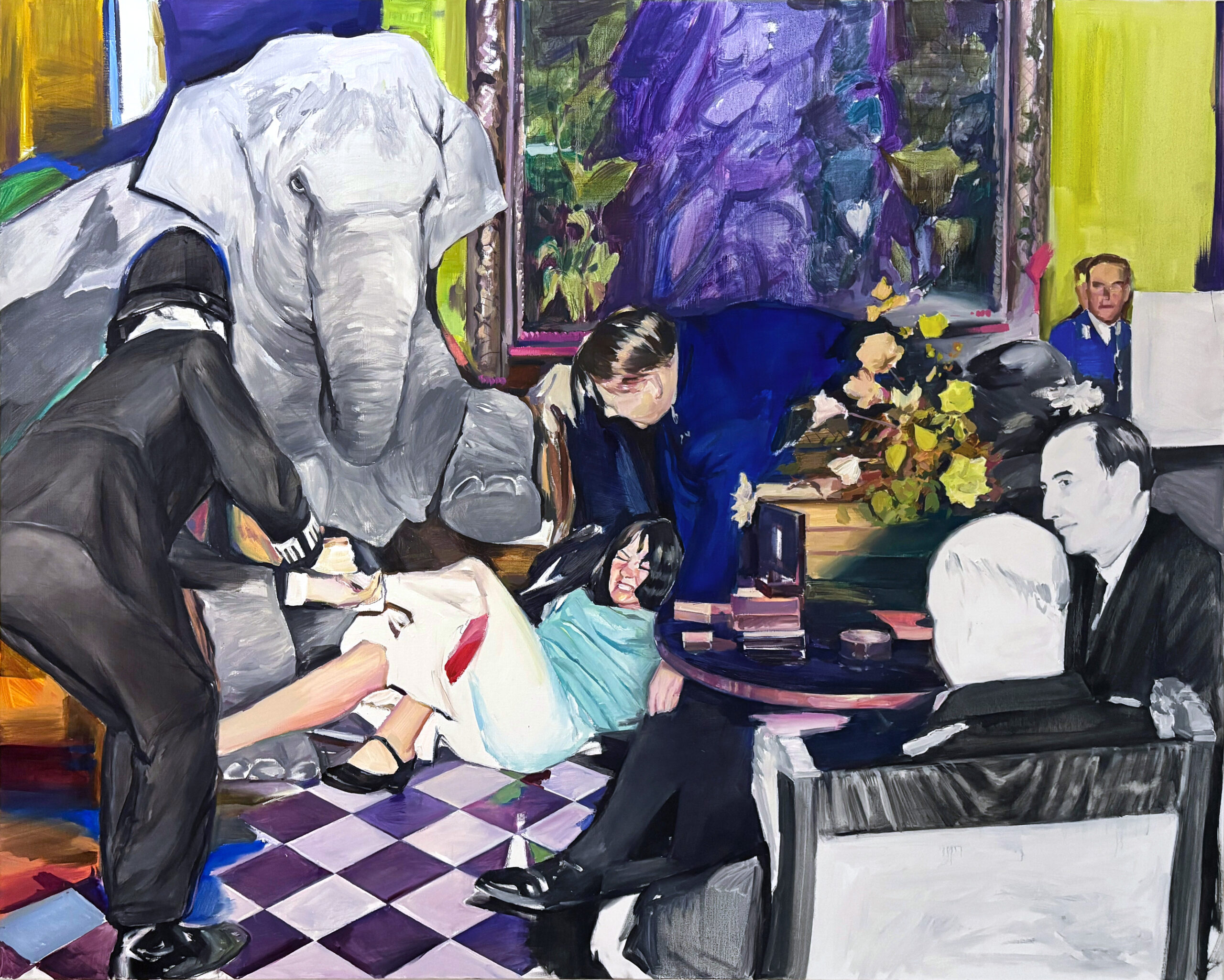
Liza Sivakova, Elephant in the room II, huile sur toile, 130 x 162 cm, 2026
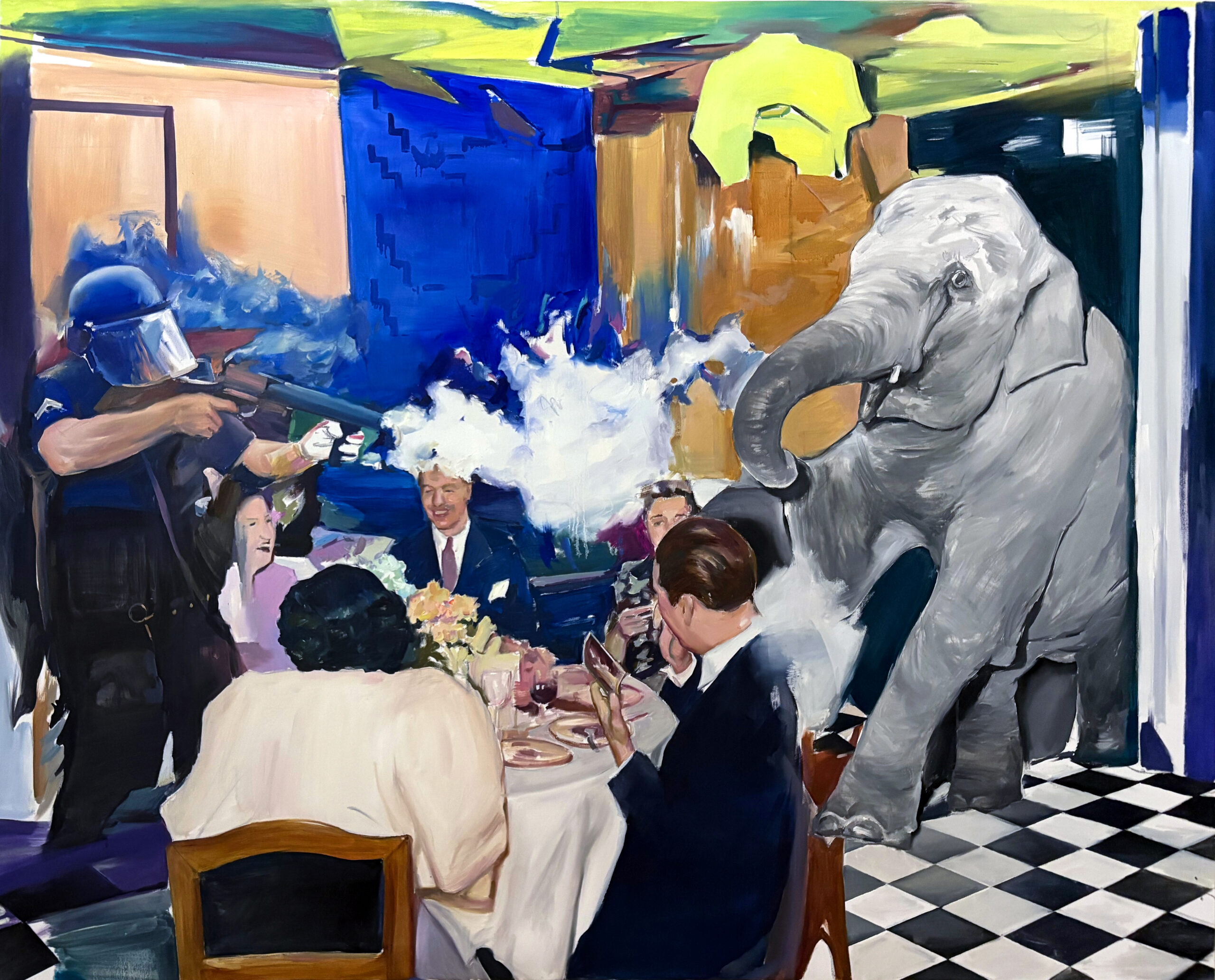
Liza Sivakova, Elephant in the room III, huile sur toile, 120 x 150 cm, 2026
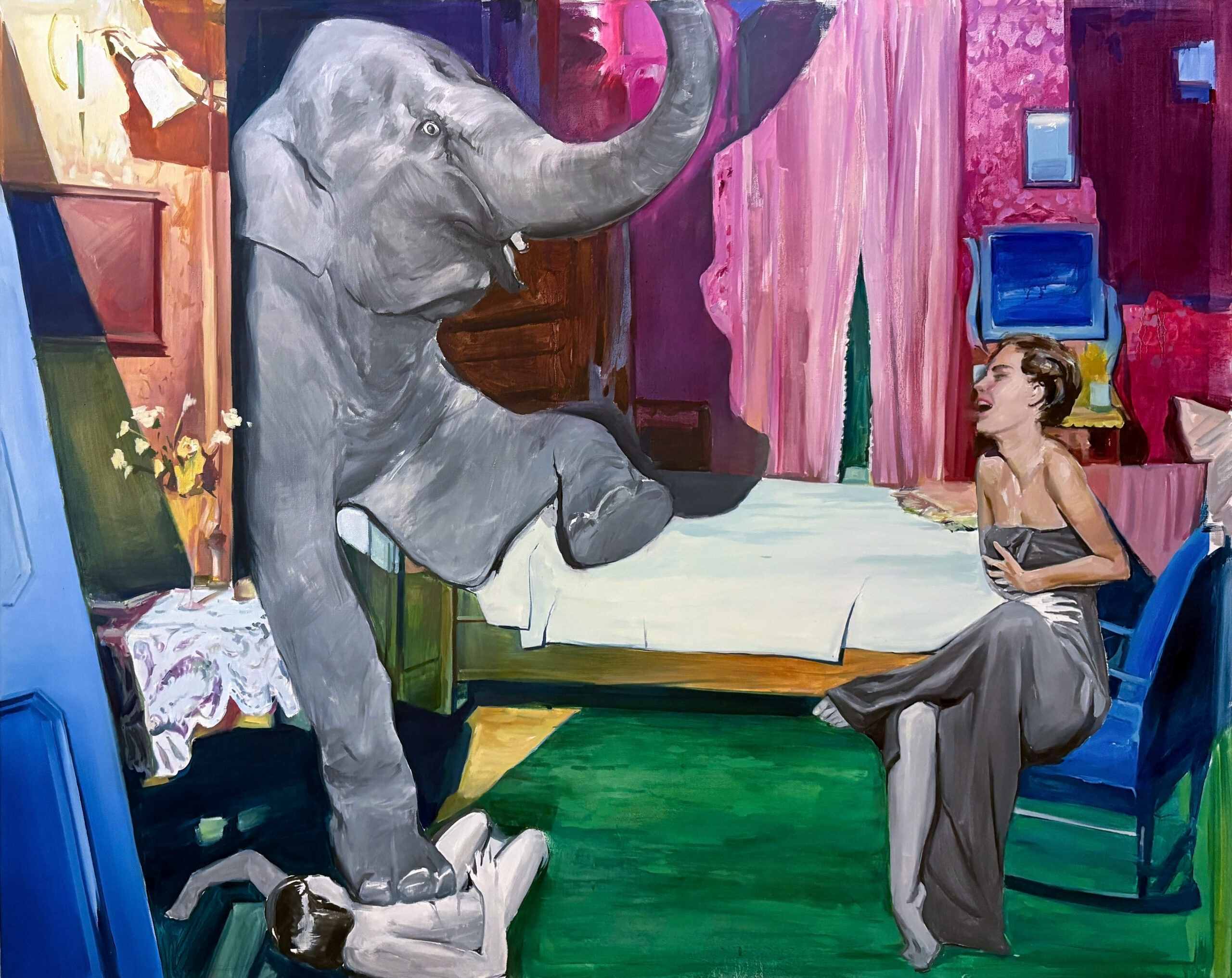
Liza Sivakova, Feeding Time, huile sur toile, 146 x 145 cm, 2026
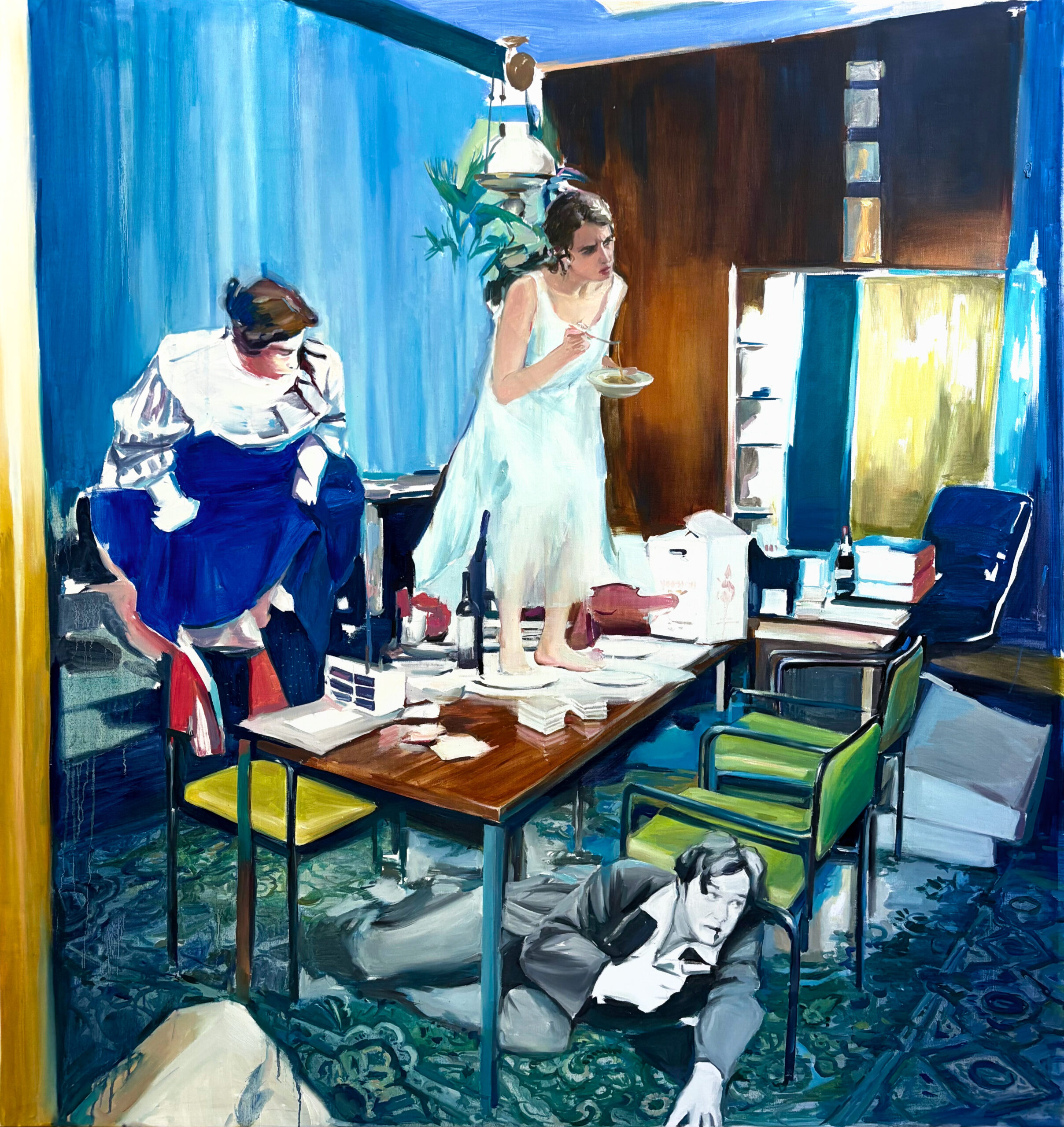
Liza Sivakova, in partes, in unum, 49 carreaux de céramique, émail, cuisson au four, 140 × 140 cm, 2026
Liza Sivakova, In Your Strong Hands I, pastel on paper mounted on wooden panel, 80 × 80 cm, 2026
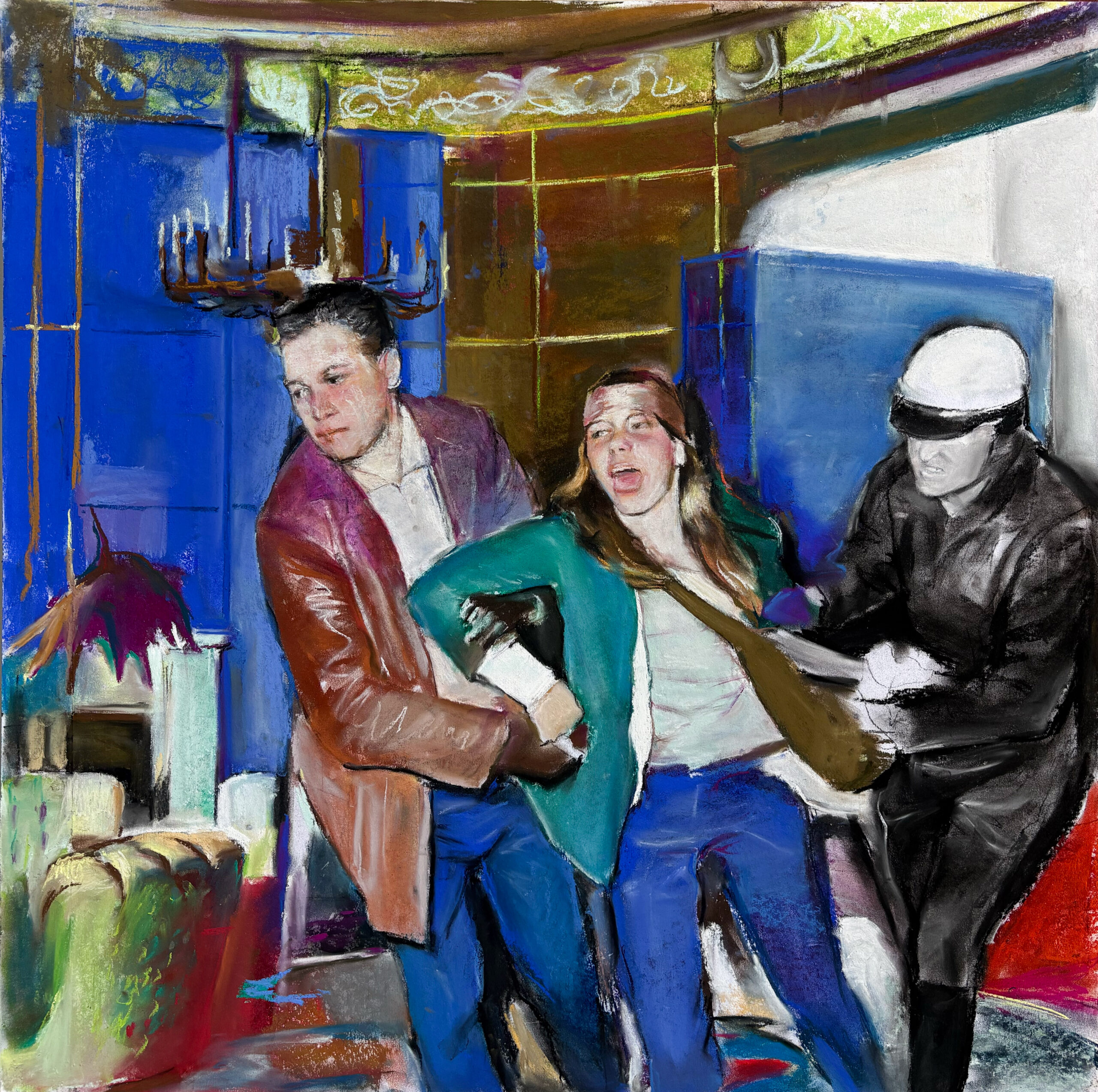
Liza Sivakova, In Your Strong Hands II, pastel on paper mounted on wooden panel, 80 × 80 cm, 2026
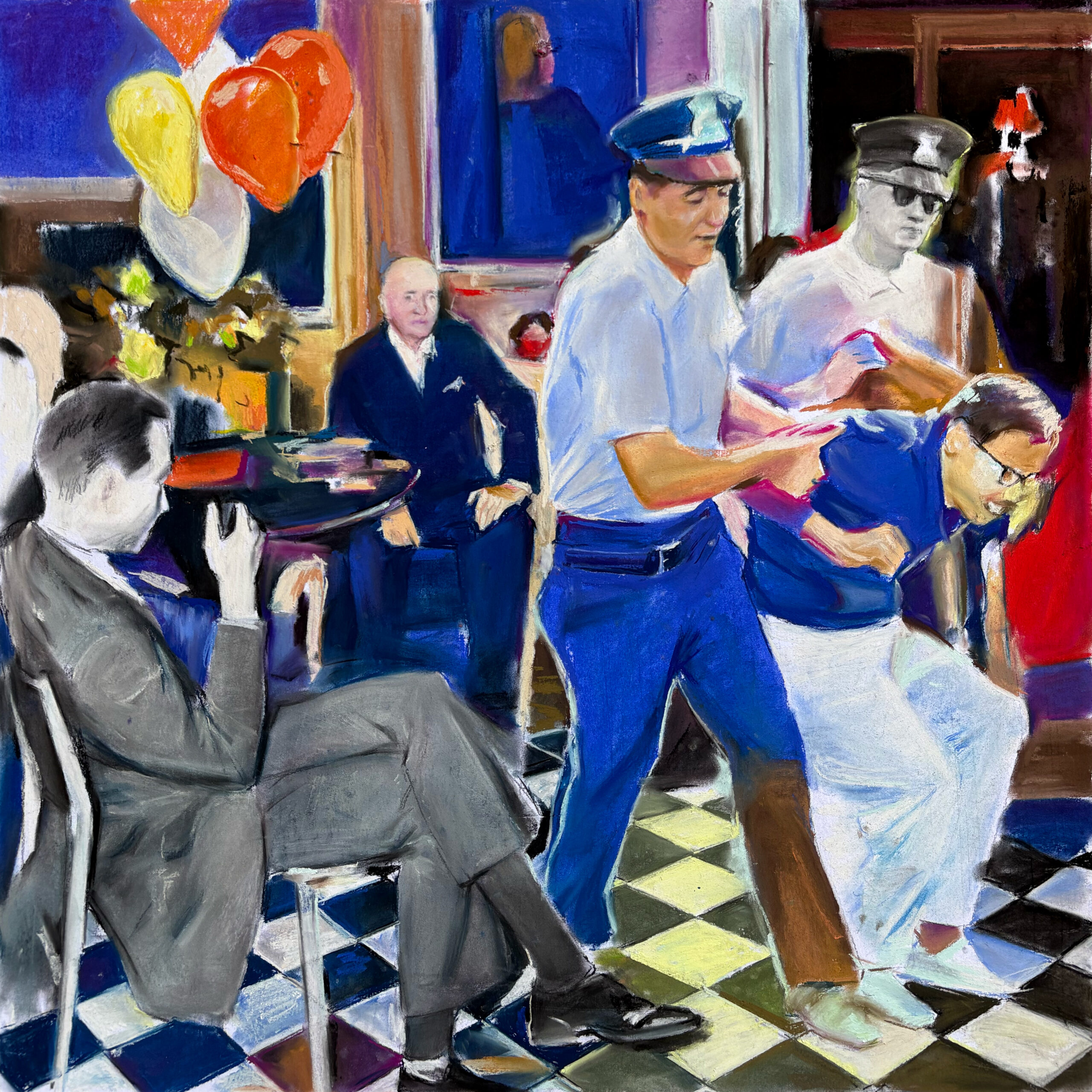
Liza Sivakova, Peace Treaty III, huile sur toile, 146 x 170 cm, 2025
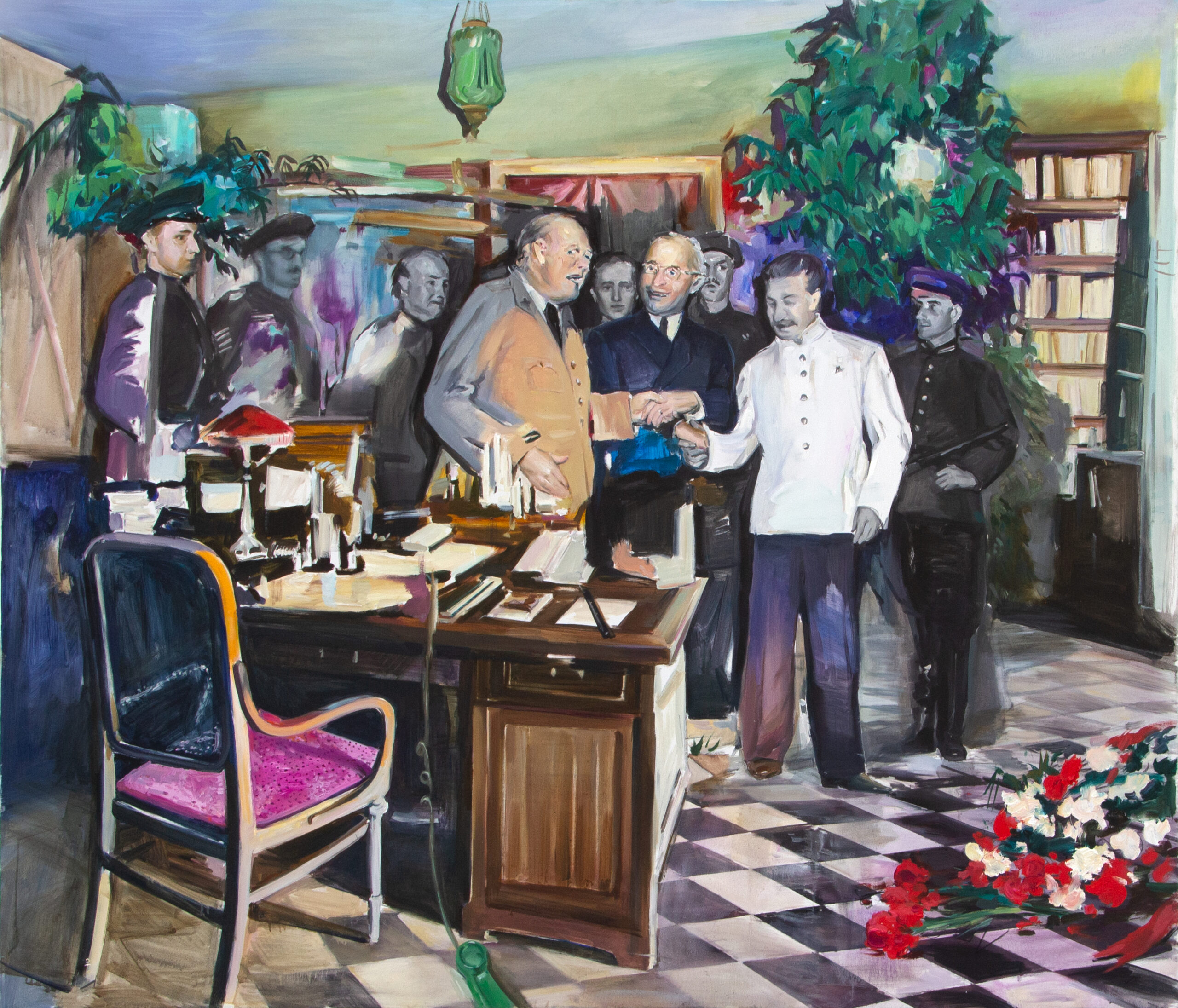
Liza Sivakova, Siesta, huile sur toile, 150 x 180 cm, 2026
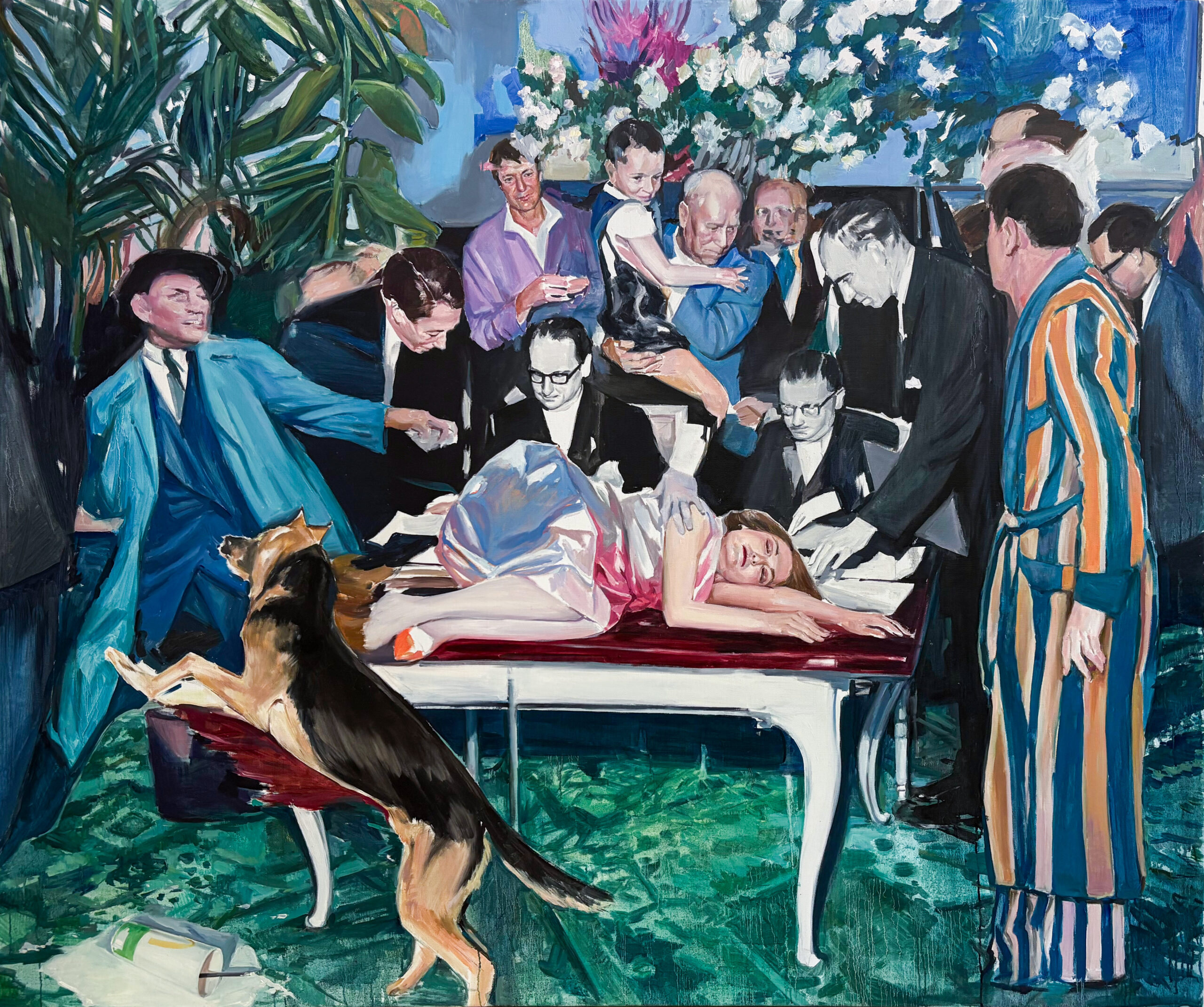
Liza Sivakova, TBC1, huile sur toile, 20 x 30 cm, 2026
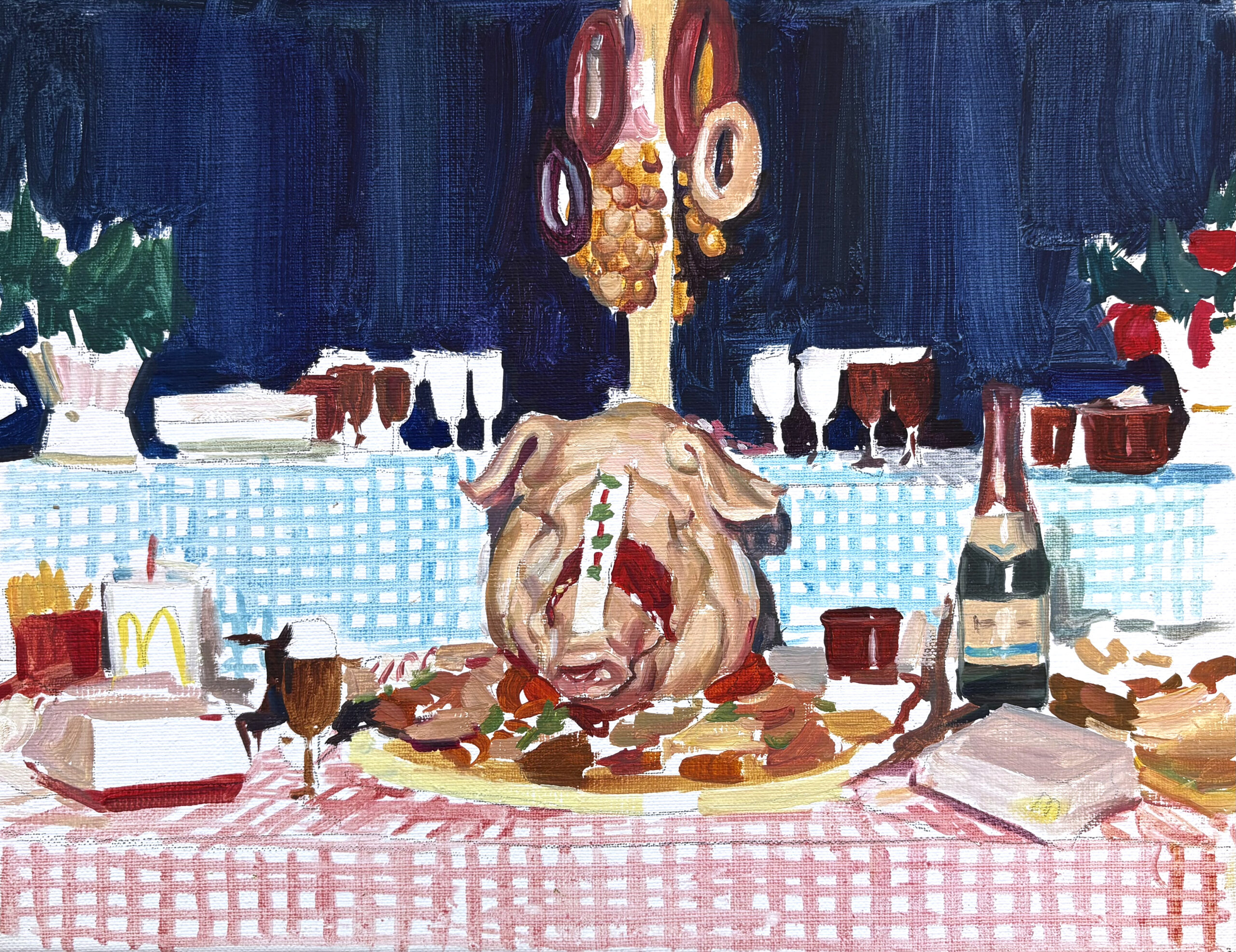
Liza Sivakova, TBC2, huile sur toile, 20 x 30 cm, 2026
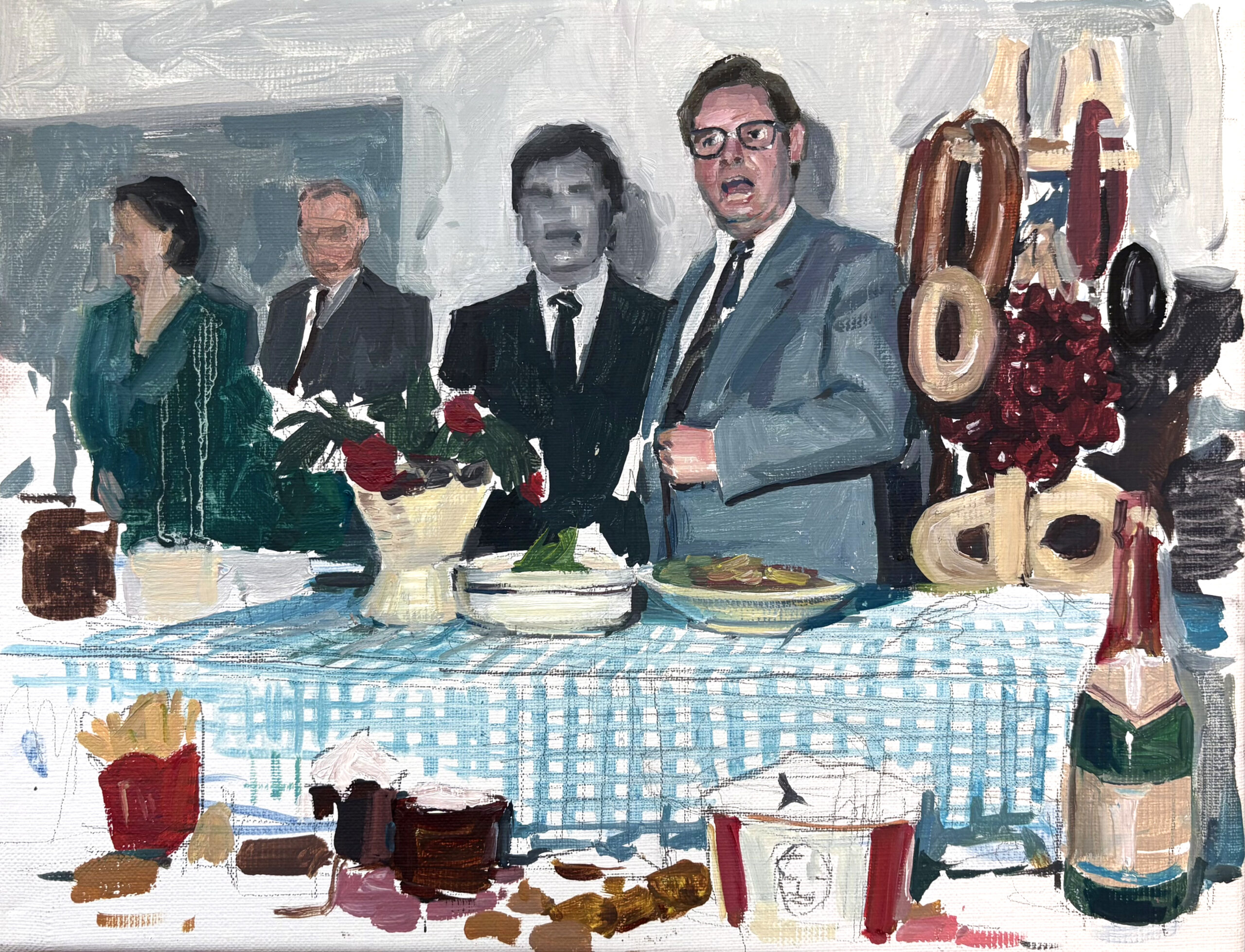
Liza Sivakova, The Anatomy Lesson, huile sur toile, 180 x 230 cm, 2025